 Русский
 English
 Español
 عربي

-

Электронная почта : rae.w@feilong-group.com
-

Тел. : +86 188 2526 5625
-

Адрес : Anhui, Hefei, China


Электронная почта : rae.w@feilong-group.com
Тел. : +86 188 2526 5625
Адрес : Anhui, Hefei, China

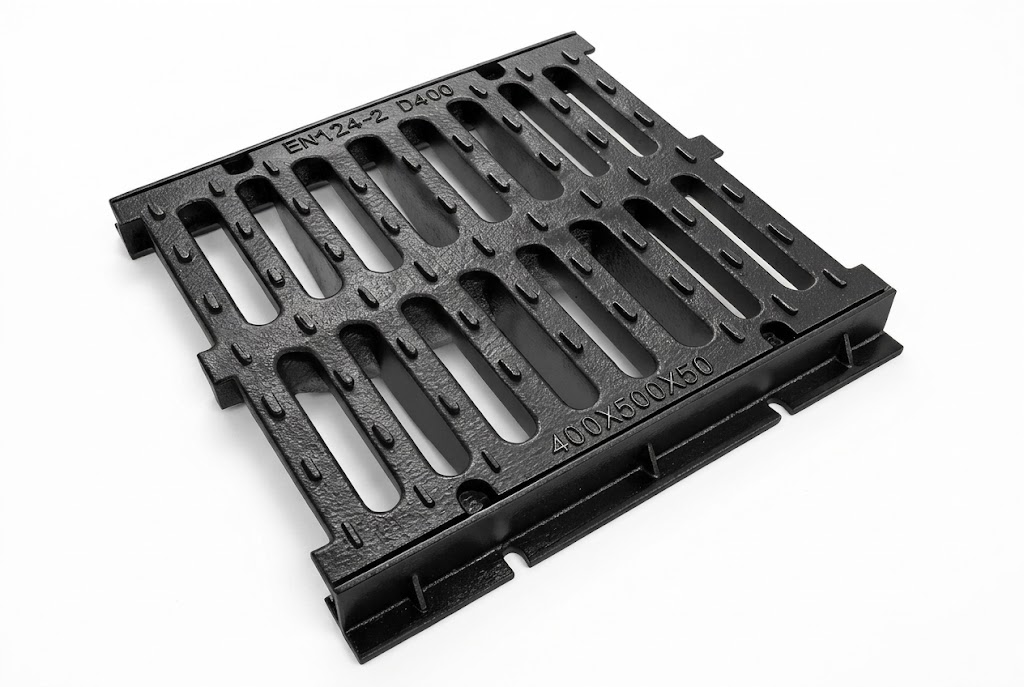
A D400 Gully Grating is a drainage grating rated to load class D400 under EN 124. It covers gully and catch basin openings in trafficked areas. You will find gully gratings like this at the low points of roads, yards, and parking lots. There they collect stormwater runoff and block debris. The D400 rating tells you the grating passes a test load of 400 kilonewtons. That load class suits Group 4 installations such as carriageways and hard shoulders. Cars and trucks can pass over it with confidence. Your choice of D400 gully gratings depends on where you install them, which material you pick, and how you seat them in a compatible frame.
D400 gully grating handles 400 kilonewtons of load, making it safe for roads and parking areas.
Use D400 grating where cars and trucks drive, like carriageways and industrial sites.
Pick ductile iron for heavy traffic and cast iron for lighter, predictable loads.
Install the grating on a compatible frame with a level surface to prevent rocking.
Clean the slots regularly to keep water flowing and avoid damage.
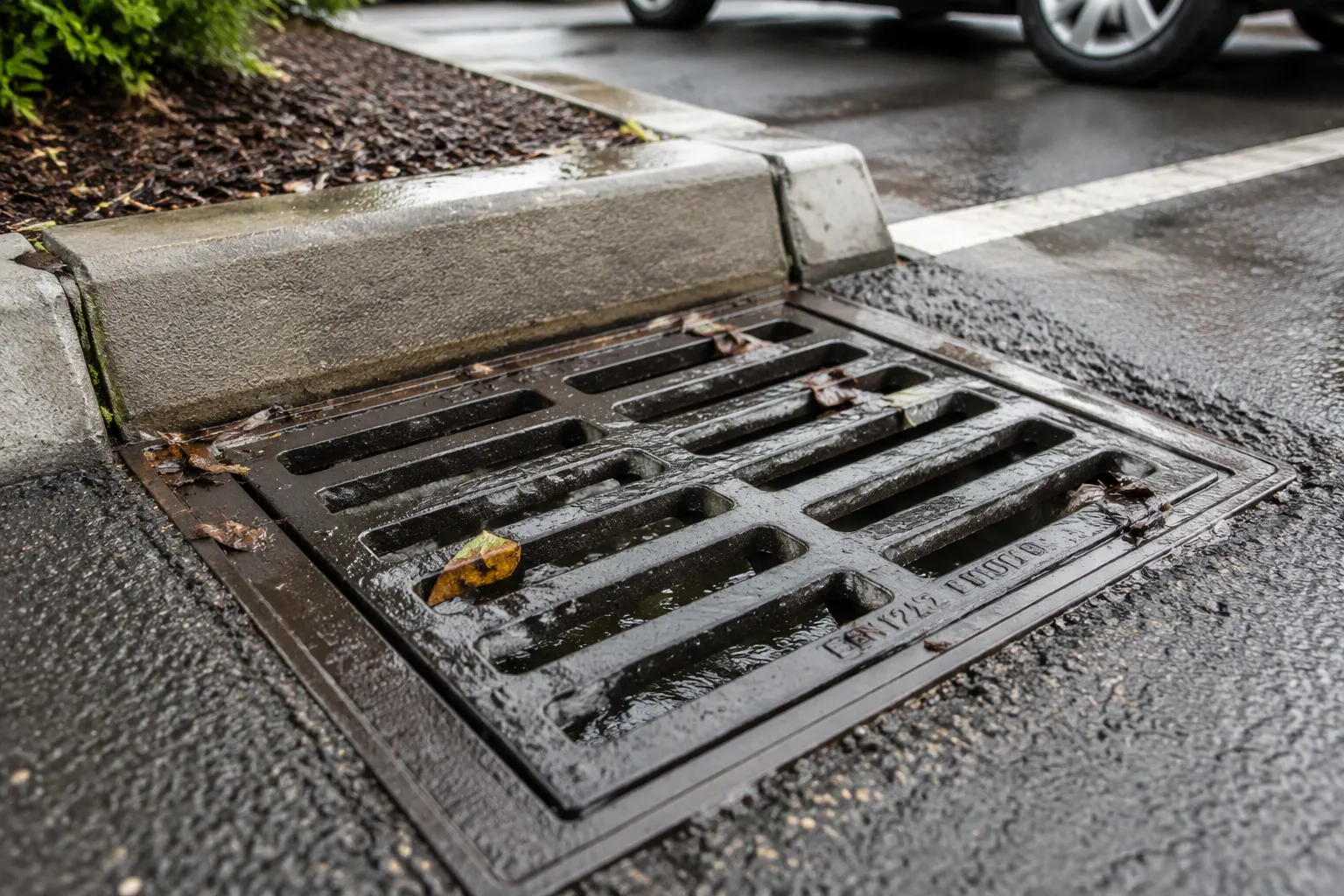
EN 124-1:2015 sorts gully tops and manhole tops into six classes based on test load. The en124 load classes run from A 15 at the light end to F 900 at the heavy end. Clause 4.2 links each class to a place of installation, dividing locations into Groups 1 to 6 and stating the minimum class recommended for each group. The specifier picks the class and material, and where in doubt, the stronger class wins.
|
Class |
Test load |
Minimum recommended group |
Installation area |
|---|---|---|---|
|
A 15 |
15 kN |
Group 1 |
Areas used only by pedestrians and pedal cyclists |
|
B 125 |
125 kN |
Group 2 |
Pedestrian areas, car parks, car parking decks |
|
C 250 |
250 kN |
Group 3 |
Gully tops in kerbside channels (max 0.5 m into carriageway, max 0.2 m into pedestrian area) |
|
D 400 |
400 kN |
Group 4 |
Carriageways of roads, hard shoulders, parking areas |
|
E 600 |
600 kN |
Group 5 |
Areas imposing high wheel loads |
|
F 900 |
900 kN |
Group 6 |
Areas imposing particularly high wheel loads |
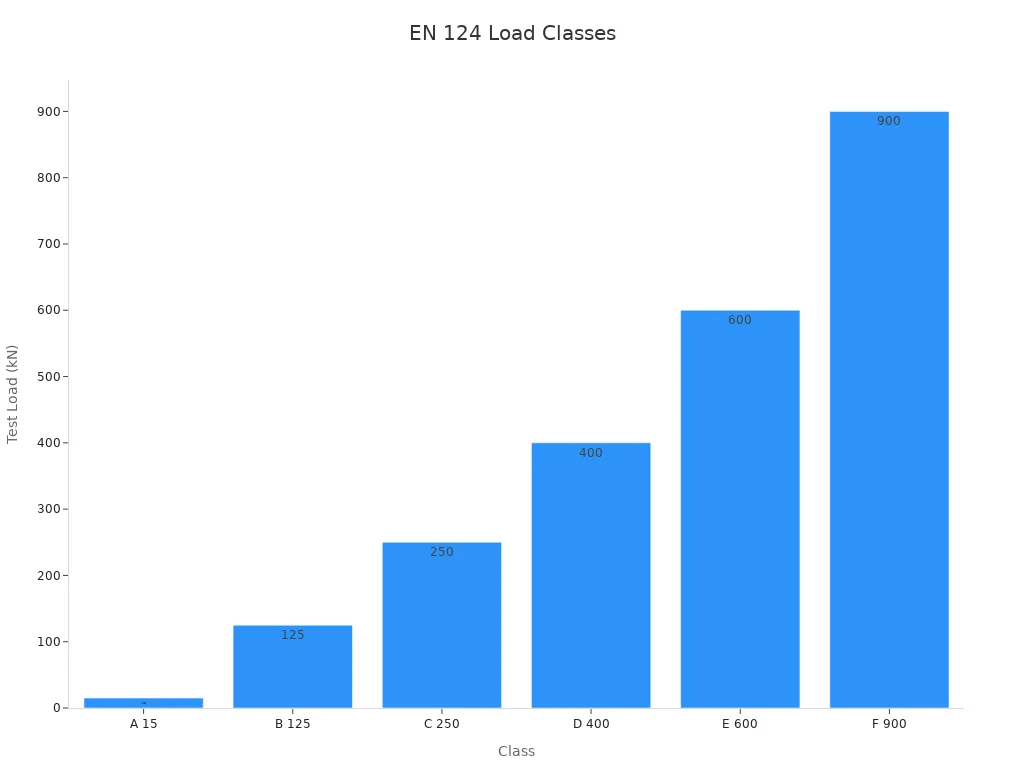
The D400 load class means the grating passes a test load of 400 kN. That figure is commonly described as roughly 40 tonnes of test load. You can read the rating as a statement about load-bearing capacity under a defined test, not a guess about real traffic. BS EN standards use this same scale, so a D400 stormwater grating carries a clear, checkable claim.
Group 4 covers carriageways of roads, hard shoulders, and parking areas. D400 is engineered for exactly these installations. Cars and lorries have access, and the grating must survive repeated wheel passes without cracking or sinking. A load classification of D400 therefore suits any spot where full vehicles cross the gully line.
Think of the rating as a floor, not a target. A light footpath needs only A 15, and a car park deck often works with B 125. The D400 gully gratings earn their place where heavy vehicles roll over the inlet every day. This stormwater drainage component protects the opening and keeps the channel clear. Choose the class to match the traffic, and the gully grate will do its job for years.
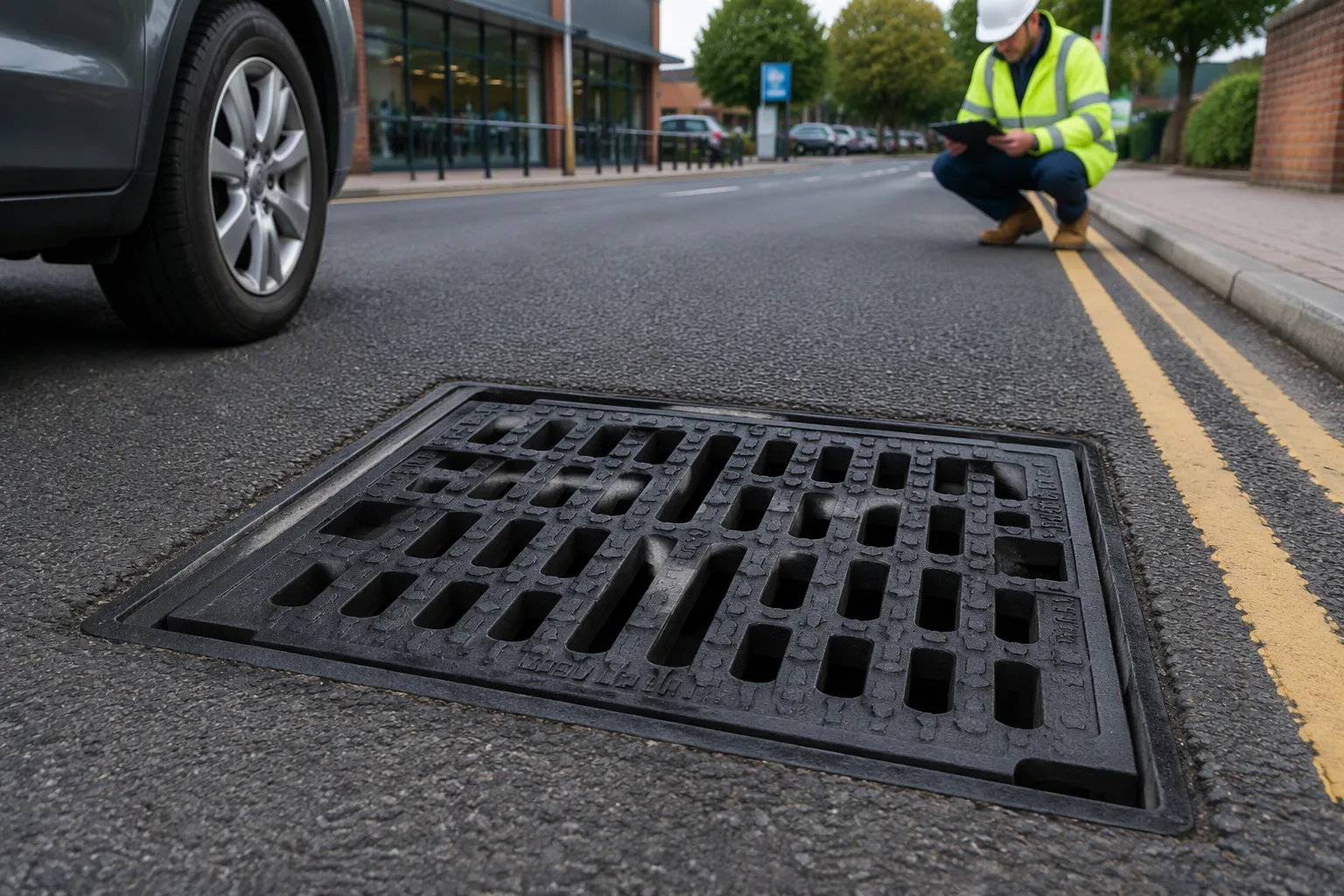
Group 4 of BS EN 124 covers carriageways, hard shoulders, and parking areas open to all vehicles. D400 is the minimum load class for that group, which makes it the baseline for most urban road infrastructure. You will see gully gratings rated to D400 along main roads, highways, and hard shoulders where regular vehicle traffic crosses the inlet line every day.
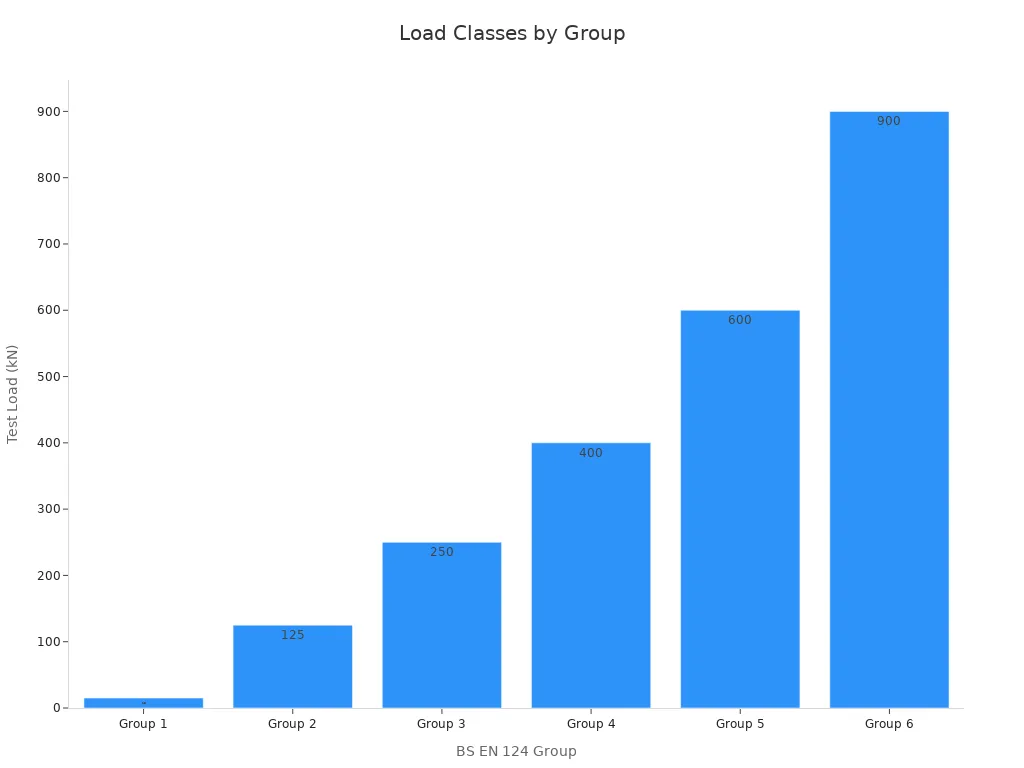
The test itself is demanding. A D400 assembly must withstand a static test load of 400 kN, roughly 40 metric tons. A standardized steel block with a rubber pad simulates tire contact, and the load is held while inspectors watch for cracking or delamination. A permanent-set test then applies about two-thirds of that load over five cycles to measure residual deformation. That repeated-load check confirms suitability for carriageways and heavy traffic.
Highway authorities sometimes go further. CD 534, formerly HA 104/09, adds enhanced requirements for motorways and trunk roads. Its AADT 1500 rule calls for E600 where light goods vehicle traffic exceeds 1,500 per direction. D400 therefore remains the benchmark for municipal and council-maintained roads, while motorway specs may step up a class.
Installation quality matters as much as the rating. A Water Research Centre study found that at least 30% of manhole cover failures stem from disintegration of the bedding mortar, not the cover itself. Professional standards require bedding mortar with compressive strength of at least 50 N/mm² and thickness of at least 15 mm. That bedding resists braking and accelerating forces and prevents sinking hazards.
Noise is another road concern. Modern D400 designs cut rattling through precision machining, elastomeric gaskets, and polyurethane damping pads. A Singapore Land Transport Authority case study recorded a 60% reduction in intersection noise levels after switching to hybrid polyurethane-pad, triple-seal units. That result supports D400 use on noise-sensitive urban carriageways.
Car parks, access roads, parking lots, and industrial sites with heavy traffic all fall within D400 territory. Municipal roads and commercial areas follow the same logic. A retail park entrance, a logistics yard, or a bus depot access lane each carries vehicles heavy enough to justify the D400 rating. The D400 Medium Duty Top Entry Grating suits these top-entry inlets, and the same range covers kerb inlet grating, side entry gully grating, and combination inlet gully grating layouts.
|
Load Class |
Test Load |
Typical Applications |
|---|---|---|
|
A15 |
15 kN |
Pedestrian areas, cycle paths, gardens |
|
B125 |
125 kN |
Private driveways, parking areas, sidewalks |
|
C250 |
250 kN |
City roads, roadside drainage, parking lots |
|
D400 |
400 kN |
Highways, industrial zones, logistics centers |
|
E600 |
600 kN |
Commercial areas with fork-lift and solid tire traffic |
|
F900 |
900 kN |
Airports, aircraft pavements, heavy industrial yards |
Lighter classes still have a place. A15 and B125 serve footways and private driveways well. C250 fits kerbside channels. D400 fits where full vehicles cross regularly, and E600 or F900 takes over in warehouses, terminals, and yards with forklifts or aircraft. Match the traffic load to the site, and the stormwater system stays clear and safe.
Cast iron gully gratings deliver solid strength at a competitive cost. Gray iron's graphite flakes sit in a rigid matrix, and that structure gives the metal good compressive strength and excellent vibration damping. Many municipal drainage programs specify cast iron gully gratings for standard road inlets, and the material performs well there. You get a stable, hard-wearing cover that resists abrasion from tires and grit.
Cast iron gully gratings suit sites where loads stay within the design envelope and shock impact is rare. A residential street inlet or a low-speed access lane is a good match. The material also machines and casts easily, so cast iron gully gratings come in the full range of standard sizes and slot patterns. Where your traffic profile is predictable, cast iron gully gratings remain a sound, economical choice.
Ductile iron changes the microstructure. Spheroidal graphite nodules interrupt crack propagation, so the metal flexes instead of shattering. The numbers show the gap clearly.
|
Property |
Gray Cast Iron |
Ductile Iron |
|---|---|---|
|
Tensile Strength |
20,000–60,000 psi |
60,000–120,000+ psi |
|
Yield Strength |
Not measurable (brittle) |
40,000–90,000+ psi |
|
Elongation |
< 1% |
2%–18%+ |
|
Impact Resistance |
~2 ft-lbs |
~7–15 ft-lbs |
Ductile iron offers exceptional tensile strength and impact resistance, ensuring construction equipment withstands harsh conditions and heavy loads, translating to longer service life and reduced downtime.
That impact figure matters at a gully line. A D400 gully grating takes repeated wheel strikes, and ductile iron absorbs roughly 7–15 ft-lbs of impact energy versus about 2 ft-lbs for gray iron. Ductile iron also yields before breaking, which warns of overload instead of failing without notice. For heavy-load road work, ductile iron gully gratings are the stronger fit.
Your range also includes GRP/composite gully gratings. They are lightweight, corrosion-resistant, and non-conductive, which suits pedestrian zones and chemically exposed areas. Match each material to its site: composite for light, corrosive duty; cast iron for standard roads; ductile iron for heavy traffic.
Start with the required load class. Confirm the traffic load the site will actually carry, then match it to the load classification in BS EN 124. A D400 rating covers carriageways and hard shoulders, and lighter classes serve footways and private drives. Getting this step right prevents overloading later.
Next, choose the material. Ductile iron gully gratings handle heavy traffic and impact, cast iron gully gratings suit predictable loads, and GRP/composite gully gratings fit pedestrian or chemically exposed areas. Then confirm the size and frame depth. Hinged ductile iron designs come in common sizes such as 430 x 370 mm and 420 x 420 mm, with 100 mm and 150 mm frame depths. Specify an anti-theft hinge with an automatic spring lock where security matters. A three-direction hinging frame lets you reverse the grating without digging up the frame when traffic flow changes. A reputable gully grating supplier will confirm exact sizing against your drawing.
Finally, plan the correct installation. Seat the unit on a compatible frame with a level, even bearing surface. Proper installation protects the load class you paid for.
Water logging usually traces to debris blocking the slots or the gully pot beneath. Clear both on a regular schedule. Cracking and rocking point to poor support, weak frames, or the wrong load class for the traffic. Prepare the channel first, check frame level and support span, and remove old concrete or rust from the bearing area. Use fixings that match the panel and frame, and never place a pedestrian-grade panel in a vehicle zone.
|
Issue |
Fix |
|---|---|
|
Grating not sitting flat |
Clean the bearing surface and check frame level |
|
Movement or uplift |
Match clips and fasteners to the panel type |
|
Frame working loose |
Use textured flange undersides and mortar holes for interlock |
|
Stress at frame corners |
Specify enlarged, rounded frame corners |
These details matter as much as material choice. Treat the gully grate and frame as one assembly, and the stormwater system performs as designed.
A D400 Heavy Duty Gully Grating is a drainage cover tested to load class D400 under EN 124, meaning it handles an impressive 400 kN and suits carriageways, hard shoulders, and parking areas. To ensure optimal performance, match the load class to real traffic conditions, pick the material for the site, and seat the unit in a compatible frame. For road projects, ductile iron is a strong fit, while standard cast iron remains economical for predictable loads and tight budgets in low-speed lanes. For pedestrian zones or chemically exposed areas, GRP/composite gratings are the ideal choice.
Match the class to the traffic. EN 124 Group 4 covers carriageways, hard shoulders, and parking areas, and D400 is the minimum for that group. Choose D400 where cars and lorries cross the inlet line regularly.
It depends on the site. Cast iron gully gratings suit predictable loads and standard road inlets. Ductile iron resists impact and deformation better under heavy traffic. Cast iron gully gratings remain economical for low-speed lanes, and ductile iron fits busy carriageways.
Hinged ductile iron designs come in common sizes such as 430 x 370 mm and 420 x 420 mm, with 100 mm and 150 mm frame depths. Specify an anti-theft hinge with an automatic spring lock. A three-direction hinging frame lets you reverse the unit without digging up the frame.
Rocking usually points to poor support or a weak frame. Clean the bearing surface, check frame level, and remove old concrete or rust. Seat the unit on a compatible frame with an even bearing surface. Correct bedding protects the load class you paid for.
Clear debris from the slots and the gully pot beneath on a regular schedule. Blocked slots cause water logging at the inlet. Routine cleaning keeps the stormwater system flowing and protects the gully gratings from unnecessary stress.

Add: Hanshan Industrial Area ( Lintou ), Maanshan City, Anhui Province, China



Пожалуйста, читайте дальше, оставайтесь в курсе, подписывайтесь, и мы будем рады, если вы поделитесь с нами своим мнением.
Авторские права
© 2026 Anhui Feilong New Material Co., Ltd Все права защищены
.
Карта сайта
|
Блог
|
Xml
|
политика конфиденциальности
 ПОДДЕРЖИВАЕМАЯ СЕТЬ
