 Русский
 English
 Español
 عربي

-

Электронная почта : rae.w@feilong-group.com
-

Тел. : +86 188 2526 5625
-

Адрес : Anhui, Hefei, China


Электронная почта : rae.w@feilong-group.com
Тел. : +86 188 2526 5625
Адрес : Anhui, Hefei, China

Hydraulic capture performance of a composite gully grating is evaluated by measuring how effectively the grating intercepts approaching surface water and directs it into the drainage system. The key factors are effective open area, slot geometry, approach flow, installation position, downstream channel capacity, and resistance to blockage. A grating with a high load class does not automatically provide high water capture efficiency.
For infrastructure contractors, drainage engineers, municipal procurement teams, and wholesale buyers, a reliable evaluation should combine hydraulic calculations, product geometry checks, and controlled flow testing. The practical indicator is the percentage of approaching water captured by the inlet rather than bypassing it. FLinSky, a composite products brand of Anhui Feilong New Material Co., Ltd., supplies SMC/BMC and FRP composite gully gratings for road drainage, kerbside gullies, parking areas, and municipal infrastructure.
Hydraulic capture performance describes the ability of a gully grating to collect surface runoff before it continues downstream. It is different from the structural load capacity of the cover and from the flow capacity of the drainage pipe or channel beneath it.
A grating may withstand the required vehicle loading but still capture insufficient runoff if its openings are too small, poorly positioned, or easily obstructed by leaves and sediment. Conversely, a large open area does not guarantee good performance if the downstream gully chamber is undersized or the approach flow bypasses the inlet.
For procurement purposes, three performance questions should be considered separately: how much water can enter through the grating, whether the supporting drainage channel can convey that water, and whether the assembly remains safe under the specified traffic load. FLinSky's Composite Gully Grating product range provides different composite configurations for project-specific drainage requirements.
The effective open area is the portion of the grating surface through which water can enter. It is not the same as the overall external dimensions. Structural ribs, frame edges, locking features, and solid sections reduce the area available for water entry.
A useful preliminary indicator is the open-area ratio:
Open-area ratio (%) = Total clear opening area ÷ Gross grating surface area × 100
For example, if a grating has a gross surface area of 0.15 m² and a measured clear opening area of 0.045 m², its open-area ratio is 30%. This figure helps compare geometries, but it should not be treated as the actual hydraulic capture efficiency. Water entry also depends on flow depth, velocity, slot orientation, and approach conditions.
Slot width, length, spacing, and direction all matter. Narrow openings may reduce the entry of larger debris but can become obstructed more easily by leaves, plastic waste, or sediment. Wider openings may increase the available entry area, but the design must also meet pedestrian safety and structural requirements.
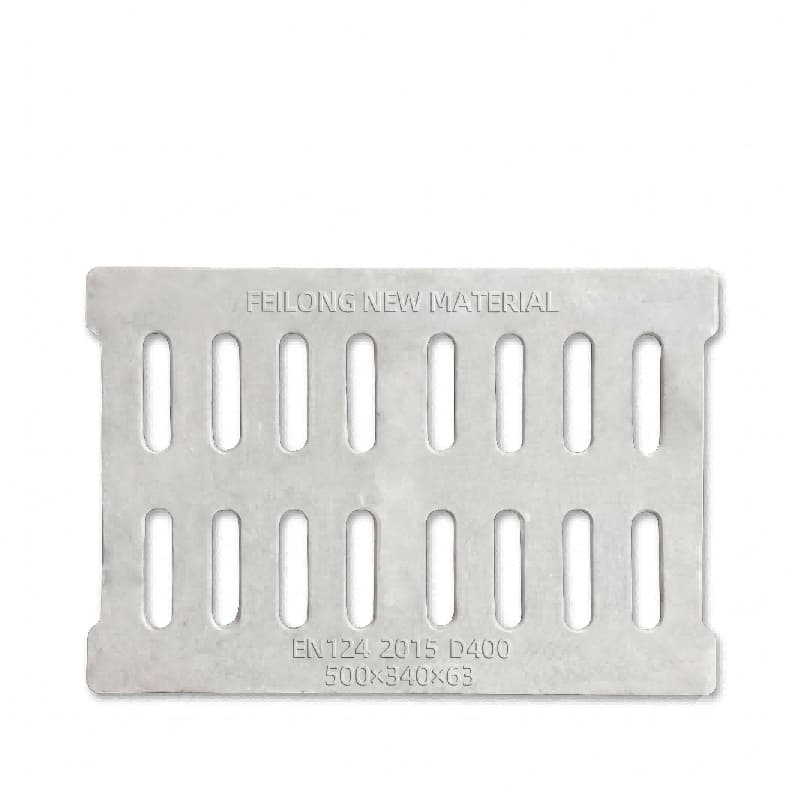
For example, FLinSky's EN124 D400 high-density SMC composite stormwater grating has published dimensions of 500 × 340 × 63 mm. Its anti-slip surface and captive structural design are intended for road and drainage applications. Buyers should request the detailed opening dimensions or an engineering drawing when comparing its effective open area with alternative grating designs.
The same grating can perform differently under different site conditions. A level approach surface, a sloped road, and a kerbside channel do not deliver water to the inlet in the same way. Flow depth, approach velocity, road crossfall, longitudinal slope, and inlet position all influence how much runoff reaches the openings.
For engineering assessment, the incoming flow rate should be estimated from the contributing catchment area and design rainfall. A simplified rational method is commonly expressed as:
Q = C × i × A
Where Q is estimated peak runoff, C is the runoff coefficient, i is rainfall intensity, and A is the contributing drainage area. Units must be consistent when applying the formula. The calculated runoff is a catchment estimate; it does not indicate how much water a particular grating will capture.
For a kerbside installation, check whether water can reach the inlet without bypassing it. A grating positioned too high, installed at the wrong angle, or separated from the road surface by an uneven joint may lose capture efficiency even when its opening area appears adequate.
A practical way to evaluate a grating is to conduct a controlled hydraulic test. Supply a known flow rate across a representative approach surface, collect the water entering the gully, and measure the water that continues past the inlet.
Capture efficiency (%) = Captured flow rate ÷ Total approaching flow rate × 100
For example, if the approaching flow is 10 L/s and the inlet captures 8 L/s, the measured capture efficiency is 80%. The remaining 2 L/s represents bypass flow. This is an illustrative calculation, not a published performance result for any FLinSky product.
For meaningful comparison, test conditions should remain consistent. Record the flow rate, water depth, approach slope, grating orientation, installation level, and debris condition. Where possible, test several flow rates to identify when bypass begins to increase. A hydraulic engineer should determine the appropriate test setup and acceptance criteria for the project.
A gully grating should not be evaluated in isolation. Water passing through the openings must enter a chamber or channel with sufficient capacity. If the downstream channel is too small, partially blocked, or poorly graded, water may accumulate beneath the grating and reduce effective drainage.
FLinSky's Heavy Duty SMC/BMC Composite Drainage Channel with Grating, model FB200-200-1000, is listed with a main size of 200 × 200 × 1000 mm. The published specifications include SMC/BMC material options, BS EN 1433 and BS EN 124-5 standards, load classes from A15 to D400, a locking system, and a double-seal gastight feature.
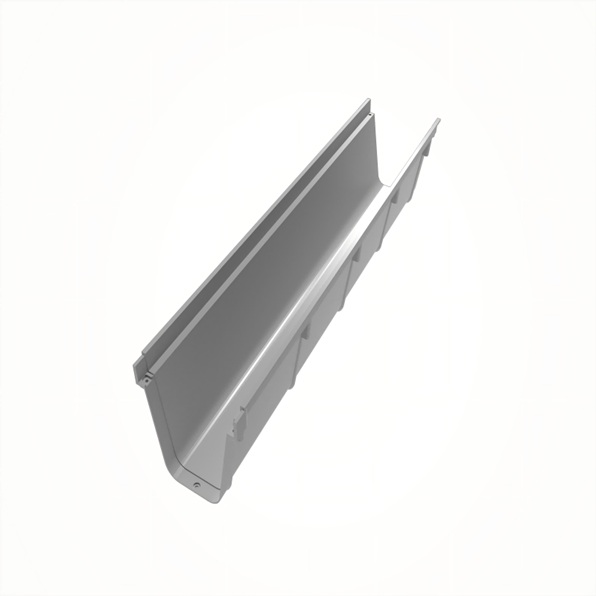
The product page describes a smooth internal U-shaped profile intended to support water conveyance and reduce sediment accumulation. This is relevant when assessing the complete drainage route, from surface collection through to downstream discharge. Review the FB200-200-1000 SMC/BMC Composite Drainage Channel specifications when the project requires a linear drainage assembly rather than a standalone gully cover.
Hydraulic capture can decline when openings become obstructed. Leaves, plastic packaging, road grit, and sediment can reduce the effective open area and create local ponding. A design that performs well in a clean laboratory test may therefore perform differently in an operating road or industrial site.
Evaluate the expected debris type, cleaning frequency, access for maintenance, and ease of lifting or removing the grating. Composite materials can offer corrosion resistance in environments exposed to moisture, salts, and certain chemicals. FLinSky's high-density SMC D400 grating is described as resistant to corrosion, UV exposure, chemicals, and de-icing salts. Its non-metallic construction also provides a practical advantage in locations where metal theft is a concern.
However, material durability does not eliminate the need for routine inspection. Maintenance teams should check for blocked slots, damaged edges, loose locking components, and settlement around the frame.
Hydraulic performance and structural loading are separate selection criteria. The load class must be appropriate for the installation location, while the grating geometry must satisfy the required water capture performance.
FLinSky's EN124 D400 SMC composite stormwater grating is specified at 500 × 340 × 63 mm and is listed as compliant with BS EN 124-5. The D400 classification corresponds to a 400 kN test load under the relevant standard, making it a candidate for specified heavy-traffic applications when the complete installation meets the standard's requirements.
For lighter pedestrian-oriented projects, FLinSky also lists BMC composite gully grating options in 300 × 500 × 40 mm and 500 × 500 × 30 mm dimensions. The product page identifies a locking system and customized color options. Confirm the applicable load class and project suitability with the supplier rather than inferring a rating from dimensions or product appearance.
See the 500 × 340 mm EN124 D400 SMC Composite Stormwater Grating for its published technical details and application information.
To help FLinSky evaluate a composite gully grating for a project, buyers should provide the installation location, design rainfall or target flow rate, contributing catchment area, road or pavement slope, required grating dimensions, traffic load class, and downstream drainage arrangement.
It is also useful to request product drawings showing clear opening dimensions, material details, load-test documentation, frame compatibility, and any available hydraulic test results. For distributors and infrastructure contractors, confirming these details before bulk ordering reduces the risk of selecting a product that meets the structural requirement but does not capture enough runoff.
How is hydraulic capture efficiency of a composite gully grating calculated?
Divide the measured flow entering the gully by the total approaching flow, then multiply by 100. Test conditions such as flow rate, slope, and installation position should be recorded.
Does a D400 composite gully grating automatically have high water capture performance?
No. D400 describes a structural load classification, not a hydraulic flow rating. Capture performance depends on open area, slot geometry, approach flow, and downstream drainage capacity.
What is the open-area ratio of a gully grating?
It is the total clear opening area divided by the gross grating surface area. It is a useful geometry indicator but does not equal actual hydraulic capture efficiency.
Which FLinSky composite gully grating is suitable for heavy-traffic areas?
The 500 × 340 × 63 mm high-density SMC composite stormwater grating is listed as BS EN 124-5 D400 and is designed for applications including urban highways, kerbside gullies, and car parks. Confirm the complete installation requirements before specification.
What is the FB200-200-1000 composite drainage channel used for?
It is a modular SMC/BMC linear drainage channel with a 200 × 200 × 1000 mm main size, designed for runoff collection in infrastructure such as highways, gas stations, logistics hubs, and industrial facilities.
How can debris affect composite gully grating performance?
Leaves, sediment, and litter can block openings, reduce effective open area, and increase surface water bypass. Routine inspection and cleaning help maintain drainage performance.
What information is needed to select a composite gully grating for a municipal project?
Provide the design flow requirement, catchment area, rainfall assumptions, site slope, installation location, required dimensions, load class, and downstream channel details. These inputs allow the supplier and project engineer to assess both hydraulic and structural suitability.

Add: Hanshan Industrial Area ( Lintou ), Maanshan City, Anhui Province, China



Пожалуйста, читайте дальше, оставайтесь в курсе, подписывайтесь, и мы будем рады, если вы поделитесь с нами своим мнением.
Авторские права
© 2026 Anhui Feilong New Material Co., Ltd Все права защищены
.
Карта сайта
|
Блог
|
Xml
|
политика конфиденциальности
 ПОДДЕРЖИВАЕМАЯ СЕТЬ
